

Tibungo
Feature Film
Creator | Writer | Director |Art Director | Storyboard Artist | Layouts
Tibungo is an original horror IP created by me.
In 2024, the Tibungo feature film project was selected in two major development grants in Brazil, enabling not only the writing of the screenplay and the design of its characters, but also the production of a promotional teaser, a glimpse into the film’s tone, visual style, and animation approach.
Now, the project is seeking partners to bring the full feature to life.
If you’re a studio or producer interested in developing an adult animated horror film with authentic Brazilian identity and strong artistic ambition, let’s talk. Tibungo is proof that animation can be just as haunting, emotional, and cinematic as any live-action story.
TEASER
Seeking to free herself from the nightmares that have haunted her for eight years, Dona Antonia surrenders all her dreams to Tibungo — a creature that emerges from her well. But her nightmares become real when Tibungo kidnaps her granddaughter and traps her in his dream world.
Early Steps in Visual Development
The first visual studies for Tibungo began with explorations using loose, quick sketches. This helped me develop the visual language from each character’s movement and capture the kind of energy I envisioned for their performances.
At this point, the concept idea of the movie was still embryonic, and the studies served mainly as inspiration for me. The characters were already there, and the environment had started to take shape, but a lot changed as the development continued.


Moodboard
After the first visual studies and the writing of the initial version of the script, it became possible to dive deeper into the film’s visual direction, and I created two moodboards to help define the atmosphere and tone I wanted to convey.
The first moodboard brings together photographic references and film stills that connect thematically and environmentally to Tibungo.
The second moodboard focuses on illustrations and animation stills.
Tibungo is set in Pernambuco, a state in Brazil’s Northeast known for its strong and distinctive colors, architecture, and cultural traits. I wanted to bring these references directly into the film in order to portray a Brazil that feels real and recognizable.
My great-uncle and I
in Bonito, countryside of Pernambuco


Character Designs
For the film’s character design, I pursued a stylized approach that still preserves a degree of realism. The facial structures follow anatomical logic even within the stylization, as I wanted to portray types of faces that are rarely represented in animation. Exaggerated cartoon proportions would not allow for the subtle anatomical details I aimed to highlight. This more naturalistic look also supports more nuanced acting and expressions, which strengthen the genre and the type of performance I wanted to bring to the animation.
Dona Antônia / Ms. Antônia

Tibungo
Kelly and Janaína


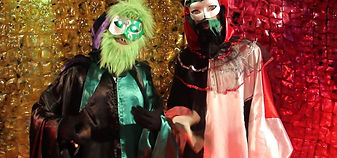


Tibungo is the film’s central mythical figure, and his design needed to be powerful, memorable, and genuinely unsettling. His visual identity is inspired by the papangus, traditional masked characters from Pernambuco’s Carnival. These figures completely hide their identity behind masks, move with a sinuous, almost slippery rhythm, and often accompany their steps with the sharp sound of castanets.
Before reaching the final concept, I explored numerous design studies, experimenting with silhouettes, masks, and movement.


Tibungo’s final design became significantly darker, as he needed to stand out as the most shadowed and ominous presence when compared to the other characters.
Line-up

Storyboard
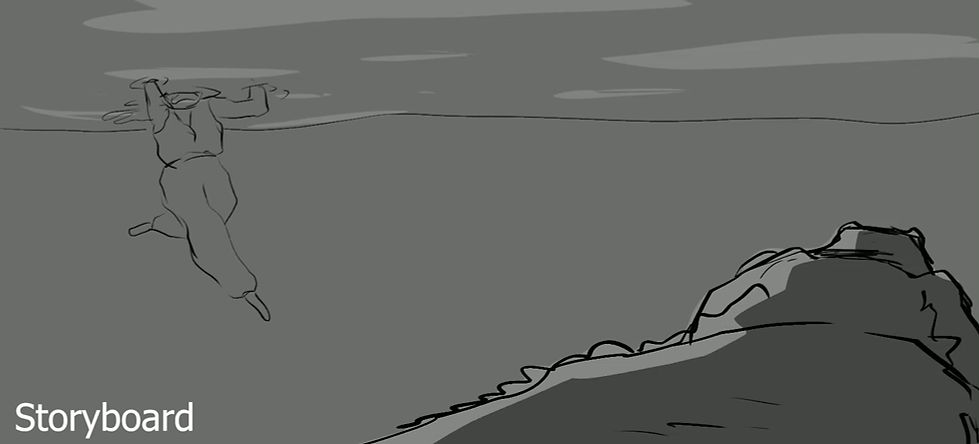
For the Tibungo teaser storyboard, my main goal was to communicate the film’s tone. I developed scenes with strong compositions, focusing on strangeness, atmosphere, and visual impact.
The animatic was initially edited using a guide track to help shape the desired tone. The cut went through several iterations until it reached a satisfying flow.
I then collaborated with musicians from Pernambuco, who composed an original score using regional instruments. Once the soundtrack was finalized, I refined the animatic, adjusting pacing and adding new shots until arriving at the final version of the teaser.

Instead of further detailing the animatic with additional poses and cleaned-up drawings, I chose to concentrate this refinement during the layout stage, when I focused on composition and posing, bringing the characters fully into alignment with the model.
Layouts and Styleframes
Given the small size of the team, I chose to create styleframes for each scene rather than producing only layouts. Locking down the frames before moving into animation gave me greater control over the final result.

Producing the layouts at this level of refinement allowed me to generate highly operational guides for every downstream department. Each layout functioned as a near-final blueprint, providing animators with explicit information on character posing, spatial blocking, camera placement, lighting direction, and the intended final compositional balance. This ensured minimal ambiguity during animation and kept performance, staging, and shot rhythm consistent across the pipeline.
The clean-up and color teams also benefited from precise line-weight references and could develop each shot’s color palette independently, giving them more control over the final look while reducing the compositing load.
For the compositing team, the layouts offered a straightforward preview of the intended final image, making it easy to identify where blur, gradients, and additional effects would be required.
Because Tibungo’s movement relies heavily on non-standard locomotion — incorporating distortions, asymmetry, and irregular silhouettes — I produced additional pose-specific layout keys for him. These extra keys established the character’s motion vocabulary early in the process and served as technical reference points for animators, helping maintain consistency in timing, line flow, and deformation across shots.


Because each shot had a fully detailed layout, any props needed for the scene were concepted directly within the layout. This ensured every prop was already designed with the correct pose, scale, lighting, and color references, allowing it to integrate cleanly into the shot with minimal adjustments.


In some of the more static shots, we were able to use the layout itself in the final scene, animating only the elements that required movement.


For more complex shots with broader pose changes, I created multiple layouts to accurately map lighting continuity and character movement throughout the scene. The two images above illustrate this approach, as they belong to the same shot.


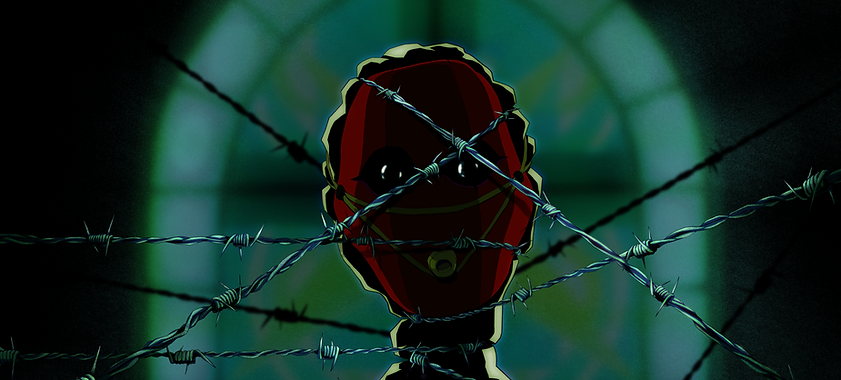


For this final shot, I knew the animation would be particularly challenging, so I prepared the entire barbed-wire element as a separate asset. I structured the scene so the animators could focus on the character and FX animation without having to redraw the wire, once its design includes a high level of detail.
Animation
Tibungo was animated by a team of six animators and three clean-up and color artists. For each shot, animators received the full layout, the corresponding animatic cut, and a detailed scene briefing, enabling a more accurate and efficient animation process.


All briefing and feedback communication was handled through SyncSketch. In Scene 17, for example, beyond the storyboard, I provided a camera-motion breakdown to clarify the required movement, and attached additional line layouts to ensure pose-by-pose accuracy in the character’s model design.

From that point, the animator began working on the shot. I reviewed each delivery by evaluating timing, spacing, and adherence to the character model, performing a frame-by-frame pass to ensure accuracy and consistency.

Revision Notes

This ensured that the animator could move on to the next stage, lighting passes, with greater accuracy, working with characters already corrected and fully on-model.
Process breakdown presented on a single frame

Animation delivery

Direction notes

Animation corrections
Scene 01

Rough Animation

Tie Down
In the scene that opens the teaser, I chose to do a rough animation pass myself to better define Tibungo’s overall movement. After that, I worked with the animator to refine the tiedown, bringing the character fully on-model and ensuring consistency in motion and silhouette.

Clean and Color (before compositing)
Scene 04
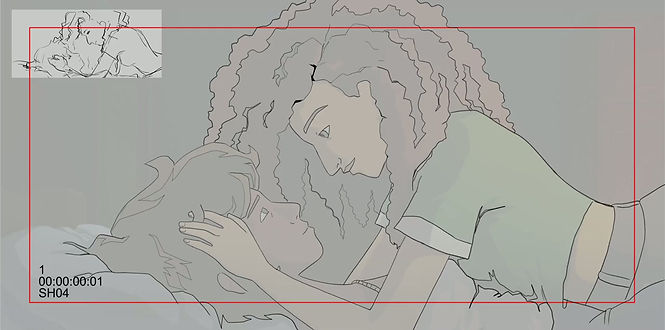


In the first animation pass for Scene 04, I requested a few model and arc adjustments. In addition to the layout I had already provided, I refined the lines directly over one of the animator’s keys, as shown on the yellow page. These corrections clarified the character’s model, added anatomical precision, and reinforced the chiseled line style we use for Tibungo.
I also indicated a change in the character’s shoulder arc, which needed to rise throughout the motion to convey more weight in the animation.
In the second animation pass, the animator matched the model more closely, but the shoulder arc still needed adjustment. I created a new feedback layer, this time indicating the expected anatomical behavior frame by frame.


With the arc corrected, the animation was finalized and approved, but since the shadow blocking was still stiff and not following the movement, I refined the shading where needed before moving on to the clean stage, adding more volume.


Finally, we reached the clean and color stage, bringing in the last lighting corrections made in the previous step.
Comp

Finally, let’s talk about compositing. In this stage, I would meet with the compositing artist to review the scene layout together and evaluate what had been delivered in the clean and color pass.
Since, in this project, we applied specific palettes to each scene already during clean and color, we eased the compositing workload. The compositor could then focus on refining the lighting—enhancing highlights, adding depth-of-field blur, or incorporating textures that couldn’t be applied earlier in the pipeline.

Clean and color
step
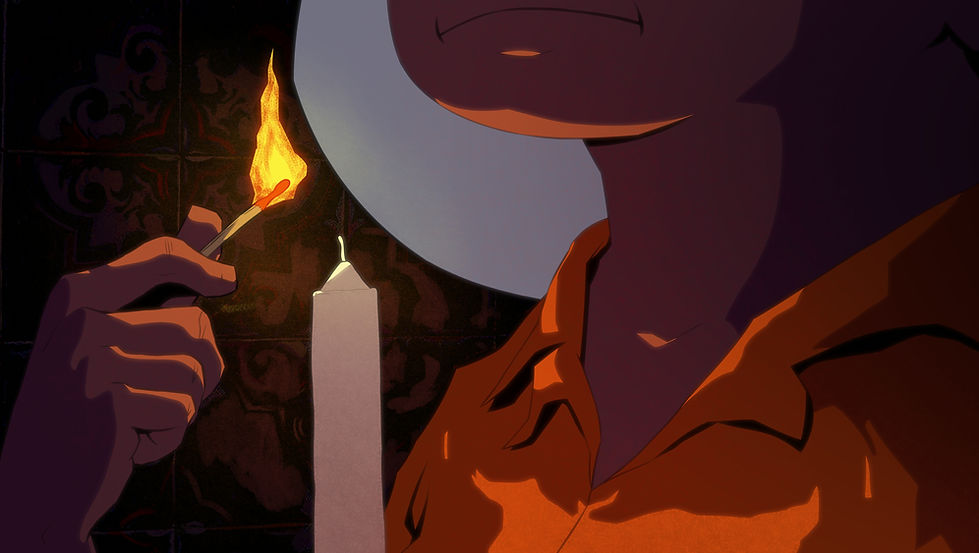
In other shots, like the one above, I wanted to apply a texture treatment to the FX. In this case, I painted the texture frame by frame to achieve the desired visual effect.
Scene Progression
Let’s take a look at the progression of the scenes, from storyboard to final composite.

Thank you for taking the time to follow the development process of this very special project. I hope you enjoyed seeing the creative and technical journey behind Tibungo, and I look forward to seeing it advance to the next stages of funding and production.
